

 This page contains listings of proposed legislation, laws on the books and other resources directly and indirectly related to solar energy in the state of Washington. Additional links to the U.S. Senate and House of Representatives are below.
As an education-focused 501c3 nonprofit organization, Solar Washington’s activities and informational resources serve an array of individuals, businesses and sectors that share an interest in solar energy and its adoption in Washington state. Often these parties do not have unanimous opinions pertaining to legislation under consideration and/or policies being enacted that pertain to solar energy. As a result, Solar Washington endeavors to provide information pertaining to, but will not endorse, any legislation.
Quick links
- Visit the Washington State Legislature website for additional information and resources about our state government, House and Senate members and committees, legislation under consideration, and more.
Skip to the bottom of the page for information on other state and federal government agencies involved in energy related initiatives and deployment.
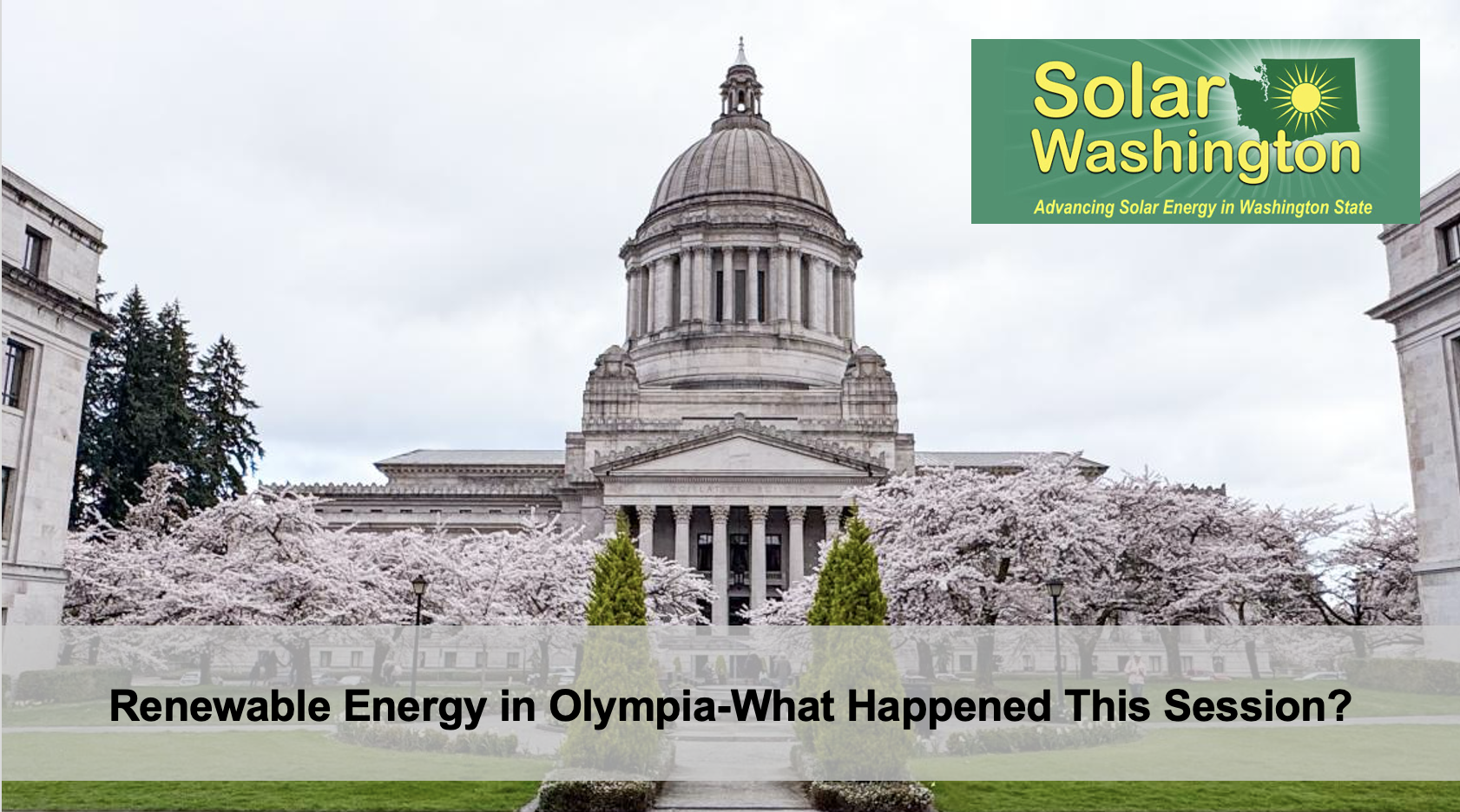
Solar Washington Webinar Presentation-2026 Legislative Session Review
Solar Washington hosted this presentation on March 26th, 2026 breaking down the key updates from Olympia's 2026 session — what passed, what didn’t, and what might be coming next for Washington’s clean energy future. Speakers Charlee Thompson, Policy Associate, NW Energy Coalition; Dever Haffner-Ratliffe, Solar Quote Check, LLC Principal; and Nora Hawkins, Interim Energy Policy Director, Department of Commerce are former Solar Washington board members who bring firsthand experience and insight from across the renewable energy sector.
LEGISLATION ON THE BOOKS
SB 6355 — state transmission authority (signed into law March 30, 2026): Establishes a state transmission authority to help build grid infrastructure. This matters for solar and battery storage because transmission constraints are a major barrier to interconnection and deployment. Link to bill.
HB 1960 — battery-storage tax law — renewable energy generation or storage tax provisions (signed into law April 1, 2026): Creates tax treatment for qualified renewable energy generation and storage, including explicit definitions for battery storage and renewable energy storage systems. Very relevant to utility-scale storage and solar-plus-storage projects. Link to bill. Link to RCW 82.96.010.
HB 1329 — wholesale power purchases under CETA (signed into law May 12, 2025): Clarifies wholesale power purchasing rules under the Clean Energy Transformation Act. Relevant to how utilities meet clean-energy obligations, which can affect solar and storage procurement. Link to bill.
HB 1216 — Clean energy siting and permitting (signed into law May 3, 2023): This legislation aims to make siting and permitting for clean-energy projects more efficient and effective. Important for solar and storage projects because permitting and siting are often major development bottlenecks. Link to bill.
HB 1257 — Energy efficiency (signed into law May 7, 2019): Updates Washington energy-efficiency policy and utility planning rules. Indirectly relevant to solar and storage because efficiency is part of the state’s clean-energy transition. Link to bill.
On May 7, 2019, Governor Jay Inslee signed into law the Clean Energy Transformation Act (CETA) (E2SSB 5116), which commits Washington to an electricity supply free of greenhouse gas emissions by 2045. Clean electricity will allow the state to replace fossil fuels in other end uses, especially transportation, and achieve its long-term climate goals. The Washington Department of Commerce is a key leader in implementing this law. Click to view the DoC's CETA webpage.
SB 5939 (Signed by Governor Jay Inslee on June 30, 2017): Promoting a sustainable, local renewable energy industry through modifying renewable energy system tax incentives and providing guidance for renewable energy system component recycling. Link to bill.
Energy Independence Act (EIA or I-937): The Energy Independence Act requires electric utilities serving at least 25,000 retail customers to use renewable energy and energy conservation. Link to the Act. Link to Department of Commerce overview.
Other state governmental agencies
The Department of Commerce is the one agency in state government that touches every aspect of community and economic development: planning, infrastructure, energy, public facilities, housing, public safety and crime victims, international trade, business services and more. DoC works with local governments, businesses and civic leaders throughout the state to strengthen communities so all residents may thrive and prosper. Click to view DoC's Energy page on their website.
The 2024 Biennial Department of Commerce Energy Report provides the governor and legislature an analysis of energy issues affecting Washington residents and businesses, along with an update on recommendations made in the last state energy strategy. Click to read the report.
The State of Washington Energy Facility Site Evaluation Council (EFSEC or Council) provides a "one-stop" siting process for major energy facilities in the State of Washington. EFSEC coordinates all evaluation and licensing steps for siting certain energy facilities in Washington including solar. Click for more information.
Federal Government
United States House of Representatives & Senate
Homepage for the U.S. House of Representatives: Link.
Homepage for the U.S. Senate. Link.
United States Department of Energy
The United States Department of Energy (DOE) is a cabinet-level department of the United States Government concerned with the United States' policies regarding energy and safety in handling nuclear material. Its responsibilities include the nation's nuclear weapons program, nuclear reactor production for the United States Navy, energy conservation, energy-related research, radioactive waste disposal, and domestic energy production. Click for the DoE's main homepage.
DOE Office of Critical Minerals and Energy Innovation
The U.S. Department of Energy’s (DOE's) Office of Critical Minerals and Energy Innovation (CMEI) is advancing America's critical minerals supply chains and accelerating next-generation energy technologies to strengthen our nation’s energy security and power our future. Click for the CMEI's homepage.
DOE Solar Energy Technologies Office
The EERE's Solar Energy Technologies Office supports early-stage research and development in the technology areas of photovoltaics, concentrating solar-thermal power, and systems integration with the goal of improving the affordability, reliability, and performance of solar technologies on the grid. Click for more information.
Make your voice heard
During the legislative session, you can call the Legislative Hotline at 1-800-562-6000 to talk with a live operator and urge your Senator and two state Representatives to vote for or against any bill. Bill description, status and votes are updated regularly. You can also find your Senator and Representatives and see a map of your district.
Support Solar Washington today!
Solar Washington is a nonprofit organization which focuses on providing solar educational resources and programs for the general public and the industry. We rely on the support from individuals and companies to bring the information on this page to you. Click to support us today! Thank you.